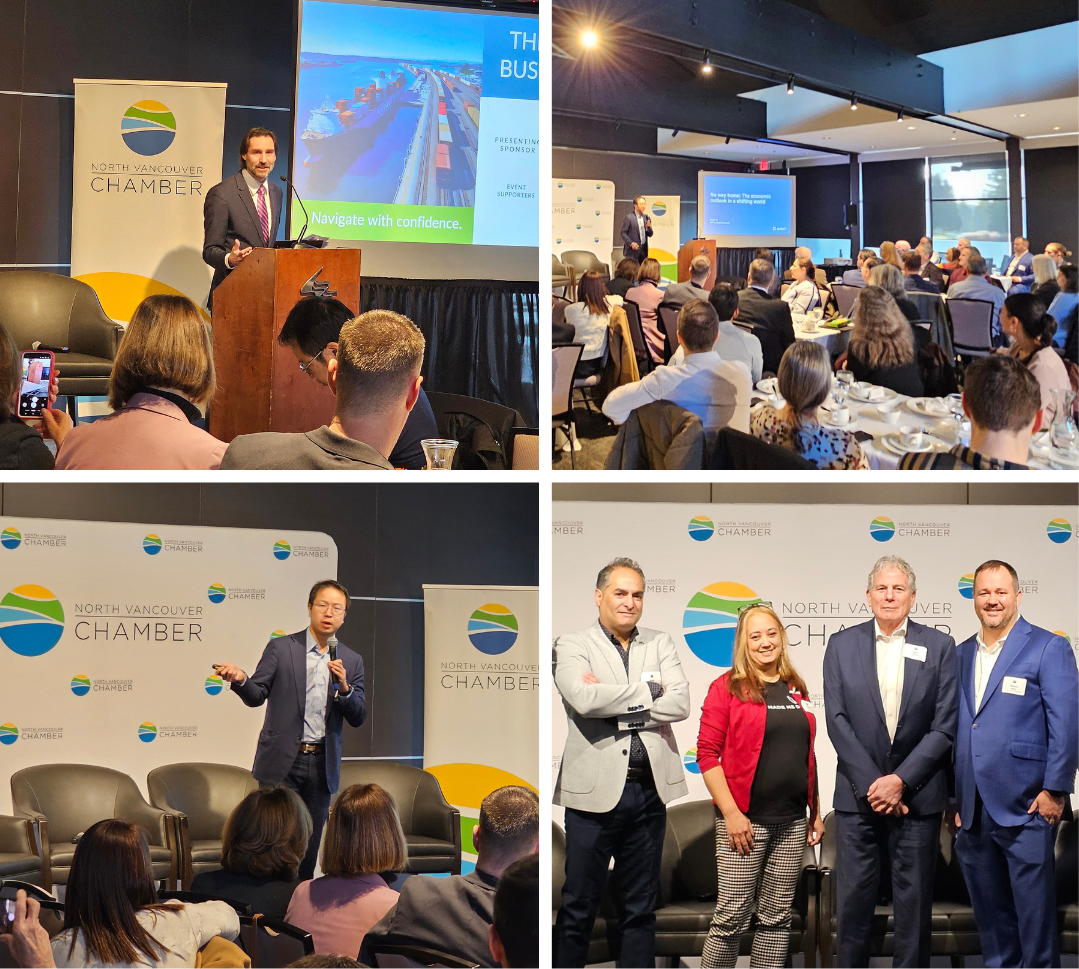
Our annual State of Business breakfast once again welcomed a sold-out audience to Seymour Golf & Country Club on January 23, where attendees heard directly from industry leaders and left better equipped to head into 2026 informed, confident, and ready for what’s ahead.
The local business community enjoyed networking while gaining timely insights into economic trends, workforce pressures, and the realities facing businesses on the North Shore.
Economic Outlook: Resilience Amid Uncertainty
Bryan Yu, AVP & Chief Economist at Central 1, set the tone with a wide-ranging economic outlook, highlighting a global economy that has proven more resilient than expected despite geopolitical uncertainty and shifting trade dynamics.
Yu emphasized that tariff uncertainty, trade realignment, and slowing population growth continue to weigh on investment and productivity. At the same time, opportunities remain through diversification of trade, major infrastructure and nation-building projects, and the growing role of artificial intelligence.
For B.C., the outlook points to extended slow growth in 2026, with housing and labour market challenges persisting but longer-term improvement expected.
Panel Discussion: Real-World Challenges and Adaptation
Moderated by North Vancouver Chamber CEO Patrick Stafford-Smith, the panel featured candid perspectives from: Amir Aminpour, Franchise Owner, McDonald’s North Shore; Kevin Hatch, Founder & President, Twin Lions Contracting; Jennifer Kom-Tong, Co-Founder, Copperpenny Distilling Co., & Gary Mathiesen, CEO, Quay North Urban Development.
Rising costs were a central theme across sectors. Panelists spoke to the compounding impacts of higher wages, materials, property taxes, insurance, and regulatory requirements. In construction, escalating costs and constantly changing codes have made projects significantly more expensive, pushing firms toward value engineering, prefabrication, and innovation to stay viable.
Workforce challenges dominated the discussion. Panelists described intense competition for talent, the affordability crisis affecting employees, and the growing need for flexibility and individualized approaches to retention. From food service to hospitality, businesses are adapting by investing more in benefits and creative solutions to support their teams.
“In Whistler, we are offering our employees a cost-of-living allowance, because I know they won’t be able to find anywhere to live in the community,” said Amir Aminpour. “Who can pay $4,000 a month just for a room to share with someone else?”
“Trying to figure out how to keep your staff is a tough one,” said Jennifer Kom-Tong. She often covers Uber rides for an employee who works late shifts and lives off the North Shore.
Regulation and permitting emerged as another shared concern. While panelists acknowledged the importance of regulation, many pointed to complexity, inconsistent interpretation, and slow permitting timelines as barriers to innovation and growth—particularly for small and medium-sized businesses. The discussion highlighted a strong desire for clearer guidance, better coordination, and more direct access to decision-makers.
Transportation and infrastructure challenges on the North Shore were also front and centre. With congestion affecting employees, customers, and supply chains, the importance of improved transit options was emphasized.
Despite the challenges the panelists spoke of, there was plenty of optimism in the room.
Kevin Hatch is inspired by Twin Lions’ collaboration with local North Vancouver schools to grow skilled trades and inspire the next generation.
“It’s one of the biggest things that I’m very passionate about—growing skilled tradespeople from the grassroots level,” said Hatch. “The skilled trades are a massive opportunity to earn some really, really good six-figure incomes very quickly. And it’s a great career.”
Jennifer, meanwhile, is excited for Copperpenny’s expansion into new markets and opportunities tied to tourism and major global events, such as the FIFA World Cup.
Gary Mathiesen expressed enjoyment about creating something that the whole community can benefit from and enjoy for years to come.
“As The Shipyards develop and Lower Lonsdale builds out, I encourage everybody to get down there and enjoy it and support the businesses,” said Mathiesen.
Amir Aminpour believes this summer will be a major boost for local businesses, thanks to tourism and the World Cup.
“I think the World Cup is the highlight of this year,” said Aminpour. “And it’s not just those games. People go to those cities a month before that, and a month after that, so this summer I believe that it’s going to be a big one for us.”
The North Vancouver Chamber thanks all speakers, panelists, and attendees for contributing to a thoughtful and timely discussion, and to Seymour Golf & Country Club for hosting another memorable State of Business event.
Thank you to The State of Business 2025:
Presenting Sponsor

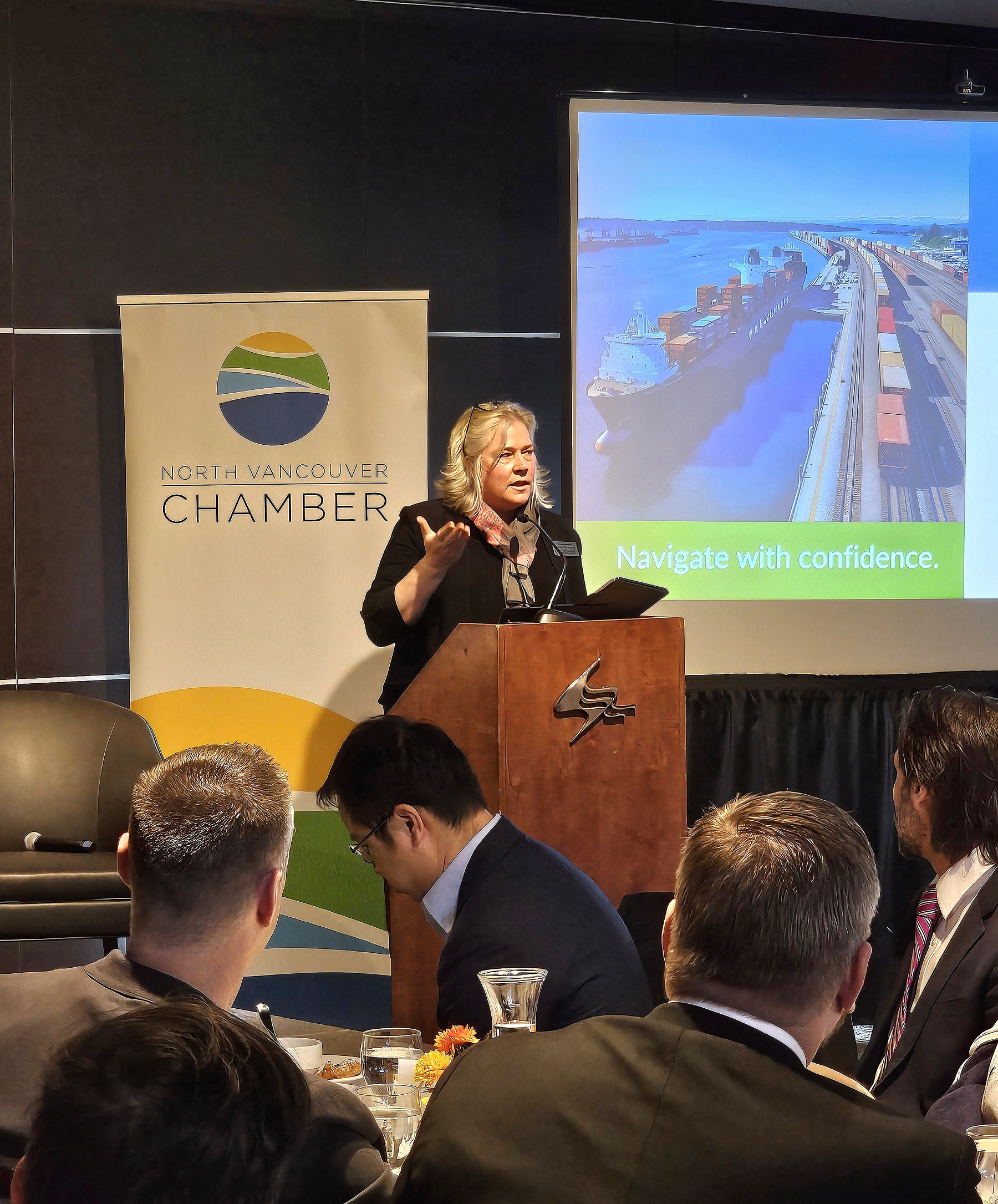
Dr. Caroline Dépatie, Dean, Global & Community Studies, Capilano University, addresses the audience.
Event Supporters